Digital construction work orders with labour, materials and signature
Replace paper work orders with mobile tickets capturing hours, van materials and client sign-off, ready for fast Peppol invoicing in Belgium.
A plumber finishes a two-hour boiler repair in Leuven, scribbles the hours and three brass valves on a carbon-copy pad on the steering wheel, and leaves the slip on the passenger seat. Ten days later, the crumpled sheet reaches the office. Half the handwriting is smudged, the call-out fee is missing, nobody wrote down the seal kit, and when the invoice finally arrives three weeks later the client disputes the hours because they barely remember the visit.
Multiply that leakage across twenty technicians or four hundred interventions a year and thousands of euros disappear every quarter. Digital construction work orders close the gap between completing a job on site and sending a clean, undisputed invoice the same week.
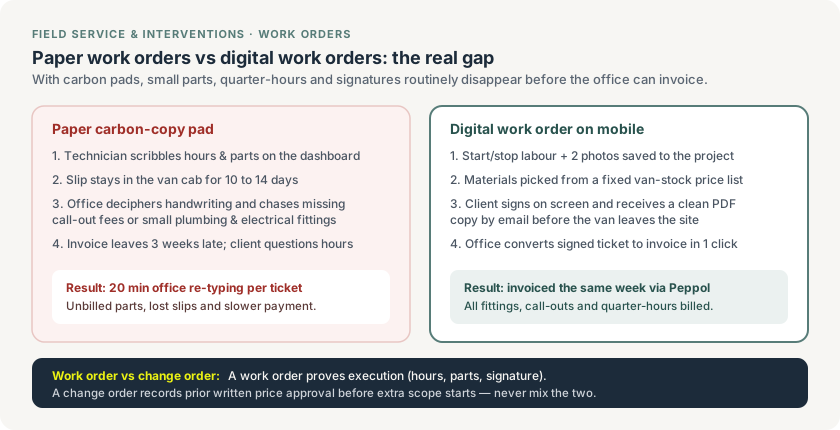
Paper carbon pads vs mobile digital work orders, and the legal boundary between a work order and a change order.
What a solid digital work order captures on site
A field technician should be able to finish a work order in under ninety seconds before starting the van. Every completed ticket needs six structured elements so the office can invoice without phoning back:
- Client, site address and project link: Pre-filled from the schedule or customer file so the ticket automatically lands under the right project or service contract.
- Work summary and technician notes: Short, clear description of the fault found and action taken ("Replaced 3-way motorised valve on ground-floor manifold; system bled and pressure-tested at 1.8 bar").
- Billable labour and call-out time: Start/stop times or duration per technician, plus travel zone or call-out fee aligned with your contractor hourly rate.
- Materials used from van stock: Picked directly from a clean short-list of common fittings, cables, seals, or consumables linked to your supplier price library.
- Before-and-after site photos: Attached directly to the ticket to prove work completed and protect against later damage claims (see our guide to construction photo documentation).
- Client name, timestamp and on-screen signature: Captures immediate confirmation on site and emails a readable PDF summary to the customer right away.
Paper carbon pads vs digital work orders: the real numbers
For Belgian HVAC installers, electricians, roofers, and renovation teams running both fixed-price projects and reactive service calls, switching from paper to mobile tickets changes both cash flow and office workload:
| Metric | Paper carbon-copy pad | Digital mobile work order |
|---|---|---|
| Time from job completion to invoice | 14 to 28 days | Same day to 48 hours |
| Office re-typing per ticket | 15 to 20 minutes | Under 2 minutes (1-click review) |
| Small fittings & quarter-hours captured | Frequently omitted or forgotten | Selected on site from van-stock list |
| Readability & client proof | Smudged handwriting, lost copies | Typed summary, photos, signed PDF emailed immediately |
| Link to Peppol B2B invoicing | Manual re-entry into billing tool | Approved lines convert straight into a UBL Peppol invoice |
Work order vs change order: never confuse the two
One of the most expensive legal mistakes on Belgian building sites is using a signed work order as proof of price for extra contract work. They serve two completely different purposes:
- A work order (werkbon / bon de travail) proves execution: It confirms who was on site, for how long, which parts were installed, and that the customer acknowledged the visit. It works well for reactive service calls, maintenance visits, and pre-agreed time-and-materials (T&M) interventions.
- A change order (meerwerkbon / bon de travaux supplémentaires) proves prior price approval: When a fixed-price renovation expands beyond the signed quote — extra sockets, an additional plastered wall, a deeper foundation — you need written agreement on scope and price before starting the extra work.
On fixed-price projects, pair your change order tickets with work orders: get the extra scope and price approved first, then record execution on the work order.
From signed work order to Belgian Peppol invoice
Once a technician submits a signed work order, the office reviews the hours, materials, and applicable Belgian VAT rate — whether co-contractor reverse-charge VAT for VAT-registered business clients, 6% renovation VAT for eligible private residences older than 10 years (with the mandatory invoice clause), or 21% standard VAT.
Because structured B2B e-invoicing over Peppol has been mandatory in Belgium since 1 January 2026, converting an approved digital work order directly into a UBL invoice with the signed PDF attached saves double entry and speeds up approval in your client's accounting system.
Four checks before choosing work order software
- Works offline in basements and rural sites: Technicians must be able to add parts, take photos, and collect a signature with zero mobile signal.
- Separates field view from pricing: Let technicians log quantities and hours without necessarily showing internal purchase costs or margins on screen.
- Handles multi-technician visits cleanly: Two fitters working three hours each on one intervention should register six billable hours without creating duplicate tickets.
- Connects directly to invoicing and time tracking: Hours logged on a work order should not have to be entered a second time for payroll or job costing.
Ready to stop chasing crumpled carbon slips in service vans? See how Enfin invoicing connects work orders, quotes and Peppol billing, compare tools in the guide to Belgian construction software, or view pricing.
Two technicians, one work order: prevent duplicate labour and materials
Separate visit duration, individual labour hours and shared materials before turning a two-person intervention into an invoice.
Why did the job margin fall? Separate price, quantity and labour variances
A worked construction example separating material price changes, excess consumption and extra labour hours without double counting.
Construction purchase orders from approval to delivery
How Belgian contractors control site purchasing with purchase orders, delivery notes, 3-way matching and Peppol supplier invoices.