Construction purchase orders from approval to delivery
How Belgian contractors control site purchasing with purchase orders, delivery notes, 3-way matching and Peppol supplier invoices.
Facade insulation I24: is free site delivery worth six extra boards?
A Brussels facade crew needs another 24 insulation boards. The buyer prepares two alternative purchase orders in Enfin using the same supplier, delivery address and €60 unit cost before VAT. These are fictional records. Only one order would be released.
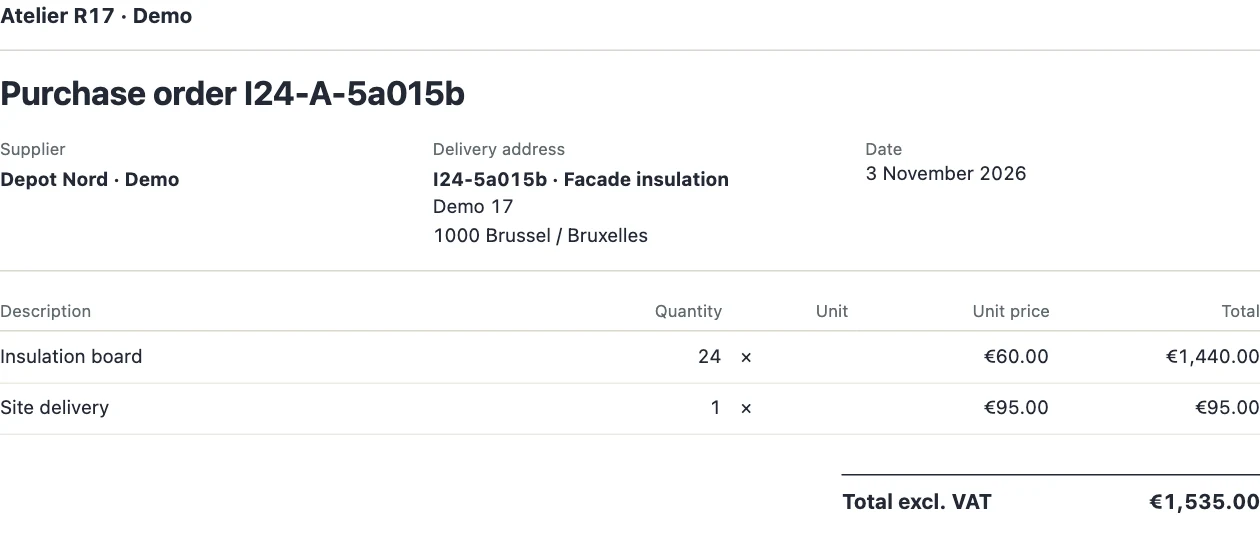
Order A covers the 24 boards the crew needs and shows the €95 delivery charge separately.
Order A totals €1,535 before VAT: €1,440 in boards plus €95 delivery. In this example the supplier waives delivery on 30 boards. Order B therefore comes to €1,800. Choosing free delivery commits another €265 and leaves six boards without a use on this job.
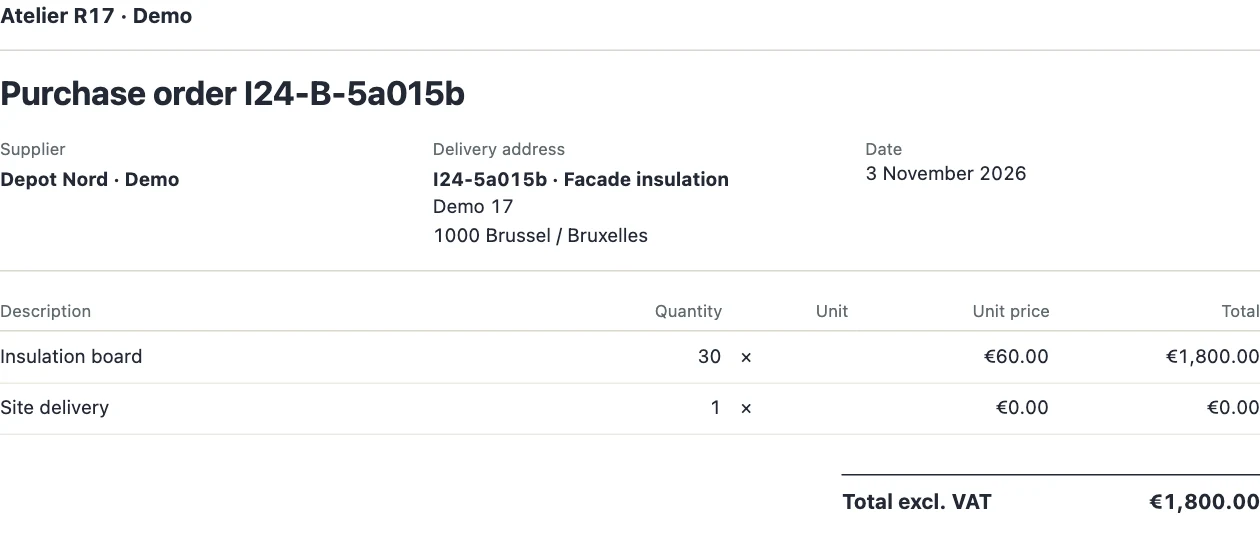
Order B has no delivery charge but raises the total commitment to €1,800.
When would B make sense? Ask the next site manager how many identical boards would replace a planned purchase. Reusing four displaces €240 of future spend, less than the €265 premium. Five displace €300 and leave €35 to cover storage and a site transfer. Until there is a named job that can take them, order A covers the confirmed requirement for less cash.
Why 3-way matching stops silent margin leaks
On small and mid-sized Belgian building sites, materials are still frequently ordered by phone or WhatsApp without a purchase order (PO) number. Four weeks later, a wholesale invoice lands in the office with twenty lines, mixed projects, unagreed crane-unloading charges, and pallet deposits nobody remembers approving.
A structured purchase order turns purchasing into a fast three-way check between what was ordered, what physically arrived on site, and what the supplier billed via Peppol.
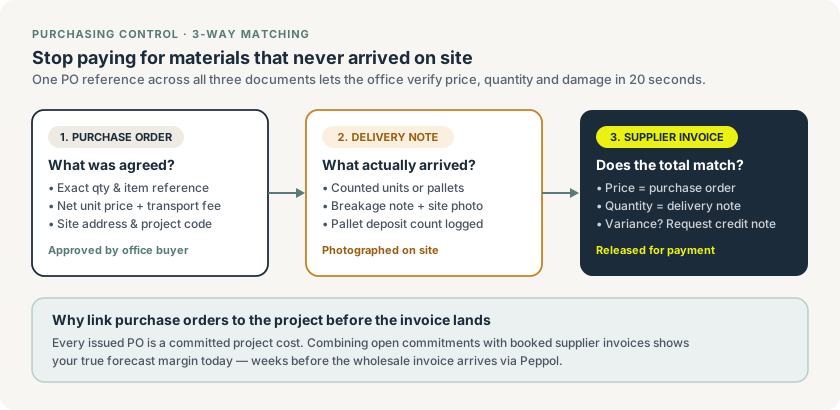
Three-way matching: link the purchase order, signed site delivery note and incoming Peppol supplier invoice under one PO number.
Each document answers a different question:
| Document | Owner | What it proves | Typical discrepancy caught |
|---|---|---|---|
| Purchase order (PO) | Office buyer / project manager | Exact item code, net agreed price, delivery fee, project code | Missing trade discount, unexpected fuel or crane surcharge |
| Delivery note (leveringsbon / bon de livraison) | Site foreman | Counted quantities, breakage, back-orders, returnable pallets | Billed for 30 boards when only 24 arrived, or 2 arrived damaged |
| Supplier invoice (Peppol UBL) | Administration / accounting | Legal payment claim referencing the PO number | Duplicate invoice, wrong unit conversion, uncredited pallet returns |
Without a PO number printed on the supplier invoice, office staff spend 15 to 20 minutes per invoice phoning foremen to ask which site ordered copper fittings three weeks ago. With a mandatory PO reference, matching takes under 30 seconds and questionable invoices are held for a credit note before payment leaves the bank account.
Track committed costs before the supplier invoice arrives
The facade insulation example above highlights a second reason purchase orders matter: cash and margin visibility. If you wait for supplier invoices to arrive before booking project costs, your project margin always lags by three to six weeks.
Every approved purchase order represents a committed cost (aangegane verplichting / engagement). Combining booked supplier invoices with open PO commitments gives you an immediate cost-to-complete picture on every active site. When a crew requests extra insulation boards or a second concrete pour, the project manager sees immediately whether the remaining budget covers it or whether the client needs to sign a change order first.
Handling partial deliveries, pallet deposits and Belgian compliance
Real Belgian building sites rarely receive one neat delivery per order. Good purchase order workflows account for three daily realities:
- Partial deliveries and back-orders: When 18 of 24 boards arrive on Tuesday and 6 follow on Friday, recording each delivery note against the same PO keeps the open balance visible so the supplier cannot invoice all 24 before the second drop arrives.
- Returnable pallet deposits: Belgian builders' merchants charge €15 to €25 per Euro or brick pallet. Logging pallet counts on the delivery note lets you track open deposits per site and verify credit notes when pallets go back.
- Peppol B2B and 30bis subcontractor checks: Since 1 January 2026, Belgian suppliers deliver B2B invoices as structured UBL files over Peppol. When your purchase order is addressed to a subcontractor rather than a materials merchant, pair PO approval with a 30bis withholding obligation check (covering both companies and self-employed subcontractors from 2026) before releasing payment, so you never inherit a subcontractor's unpaid social security or tax debt.
Connect your purchase orders to a net price library
Purchase orders work fastest when buyers do not re-type product codes and unit prices on every order. Linking your PO workflow to a maintained supplier price library means agreed net prices, pack-to-unit conversions, and preferred wholesalers load automatically. If a supplier raises prices on an incoming invoice above the PO rate, the variance jumps out immediately.
Practical steps to roll out purchase orders without slowing down site crews
- Set a simple threshold: Require a PO number for every supplier order above €150 and for all subcontracted packages; keep small counter pick-ups under a monthly van-stock cap with receipt photos.
- Tell wholesalers "no PO, no payment": Give your main Belgian merchants a clear rule so they put your project and PO reference in the Peppol BuyerReference / OrderReference field.
- Require a delivery-note photo on arrival: Foremen snap the signed docket (plus any damaged pallet) straight into the project folder before the driver leaves.
- Match once a week: Release matched Peppol invoices in batches and request credit notes immediately on price or quantity variances.
Want to see how purchasing fits alongside quoting, progress billing and site follow-up? Read the guide to Belgian construction software, explore Enfin construction software, or view pricing.
Forecast final job margin with open purchase orders
Use a Belgian contractor’s worked example to reconcile posted costs, outstanding orders and the cost of remaining work before handover.
Construction purchase request approval before a supplier order is placed
Connect site need, budget, specification, supplier choice and approval before a construction purchase becomes a binding order.
Construction delivery-to-invoice variance workflow
Resolve quantity, price, damage and back-order differences across purchase orders, delivery notes and supplier invoices.