A supplier price library for more reliable construction quotes
Build a Belgian construction supplier price library with net purchase prices, normalised units and composite cost assemblies for accurate quotes.
A Belgian renovation contractor copies an old quote from nine months ago, adjusts the square metres, and sends it out before the weekend. The client signs on Monday. Three weeks later, when the buyer places the order at the wholesaler, copper pipe is up 14%, PIR insulation went up twice since winter, and the old spreadsheet still used last year's plasterboard price. Before the first screw goes into the wall, half the expected margin is already gone.
A structured supplier price library eliminates copy-paste estimating. Instead of hunting through PDF price lists, old emails, and wholesaler portals for every bid, your estimators quote from one central database of net purchase prices, normalised units, and reusable composite cost assemblies.
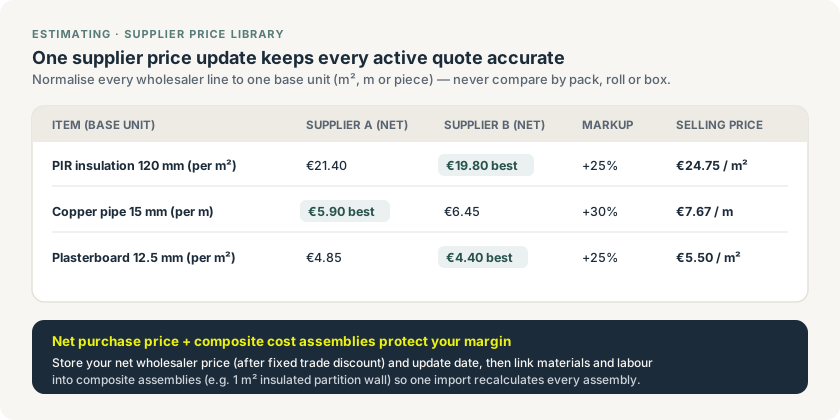
Normalise supplier lines to one base unit, store net purchase prices rather than gross list prices, and feed composite quote assemblies automatically.
Net purchase price vs gross catalogue price
The single most common estimating error in Belgian construction is importing gross manufacturer catalogue prices without applying your actual wholesaler discount — or worse, mixing gross prices from one merchant with net prices from another.
Belgian building materials merchants, electrical wholesalers, and HVAC distributors routinely apply trade discounts ranging from 15% to 55% off list price depending on product family. If your library stores only the gross price, your quotes either price you out of competitive tenders or force manual percentage guesses on every line.
Store four mandatory fields per supplier item:
- Supplier article code / EAN: Allows fast CSV or Excel price-list re-imports without creating duplicate items.
- Net purchase price (excl. VAT): Your real cost after fixed trade discounts, never the inflated list price.
- Base calculation unit: Standardised across suppliers (
m²,m,piece,kg,litre). - Last-updated date and validity: Flags stale prices older than 90 days before an estimator relies on them.
Normalise pack units so suppliers stay comparable
Comparing Supplier A and Supplier B is impossible when one quotes PIR insulation boards at €118.80 per pack of 6 m² and another quotes €15.84 per 0.80 m² board. Normalising every line to its base unit reveals the real gap instantly:
| Material | Wholesaler packaging | Raw quote | Normalised base unit | Net unit cost |
|---|---|---|---|---|
| PIR insulation 120 mm (Supplier A) | Pack of 5 boards (6.0 m²) | €128.40 / pack | per m² | €21.40 / m² |
| PIR insulation 120 mm (Supplier B) | Pack of 4 boards (4.8 m²) | €95.04 / pack | per m² | €19.80 / m² |
| Copper pipe 15 mm (Supplier A) | Bundle of 10 × 5 m (50 m) | €295.00 / bundle | per m | €5.90 / m |
| Plasterboard 12.5 mm (Supplier B) | Sheet 260 × 120 cm (3.12 m²) | €13.73 / sheet | per m² | €4.40 / m² |
Keep the supplier's purchasing pack size stored as a secondary ordering factor. That way your estimator quotes cleanly per m², while your purchase order automatically rounds up to whole packs or pallets when ordering from the merchant.
Build composite cost items (assemblies) for fast, consistent quoting
Quoting raw materials line by line takes forever and leaves room to forget screws, joint tape, waste percentages, and installation minutes. Once your underlying supplier items carry clean net prices and units, combine them with your contractor hourly rate into composite assemblies (samengestelde posten / ouvrages composés).
For example, a single composite assembly for 1 m² of insulated interior partition wall (120 mm) bundles:
- Metal stud framing & perimeter tracks (incl. 8% waste)
- Mineral wool or PIR infill per m²
- Two layers of 12.5 mm plasterboard + screws + joint compound
- 0.75 hours of installation labour
- Fixed material markup and general overhead percentage
When your wholesaler sends a Q2 price update for plasterboard or steel studs, updating the underlying material record automatically recalculates every composite assembly that uses it — keeping active quotes accurate in seconds rather than hours.
Keep your library lean and maintained
Many contractors fail by importing 80,000 wholesaler SKUs on day one and drowning in clutter. A high-performing price library for a Belgian SME follows the 80/20 rule:
- Start with your top 150–300 recurring items: Cover the materials that represent 80% of your spend and build 25–40 core composite assemblies around them.
- Schedule quarterly price refreshes: Import updated net price CSVs from your top three wholesalers once a quarter, and immediately after major supplier announcements on copper, steel, timber, or insulation.
- Feed real purchase variances back into estimating: When a Peppol supplier invoice comes in higher than the purchase order price during 3-way matching, update the library record on the spot so the next quote reflects reality.
- Set clear quote validity periods: Even with a clean library, state a 30-day validity window on every quote sent via digital quote signing, with an explicit price-revision note for volatile materials.
Want to turn accurate supplier prices straight into fast quotes, orders and project margin tracking? Explore Enfin estimating, compare options in our guide to Belgian construction software, or view pricing.
How to Create a Reliable Site Report for Your Construction Projects
Practical guidance for Belgian construction SMEs on documenting daily work, essential elements, frequency and digital tools for effective site reporting.
Construction customer change request: approve scope and price before work starts
Turn an informal customer request into a documented scope, cost, schedule impact and authorised decision before execution.
Why did the job margin fall? Separate price, quantity and labour variances
A worked construction example separating material price changes, excess consumption and extra labour hours without double counting.