Digital quote signing in Belgium: eIDAS validity and workflow
How digital quote signing works in Belgium under EU eIDAS, when to pick Simple, Advanced or Qualified signatures, and what audit proof to keep.
A Belgian homeowner reviews your €18,500 roof-insulation quote at 21:30 on a Tuesday evening and wants to confirm on the spot. If your process requires printing eight pages, signing in pen, scanning them on a printer they do not own and mailing them back, approval slips to next week — or stalls while they call a second contractor.
Digital quote signing removes that friction and produces a cleaner legal record than a blurry phone photo of a handwritten signature. Under Belgian and EU law, electronic acceptance is fully enforceable when you match the signature level to the contract value and keep the audit trail intact.
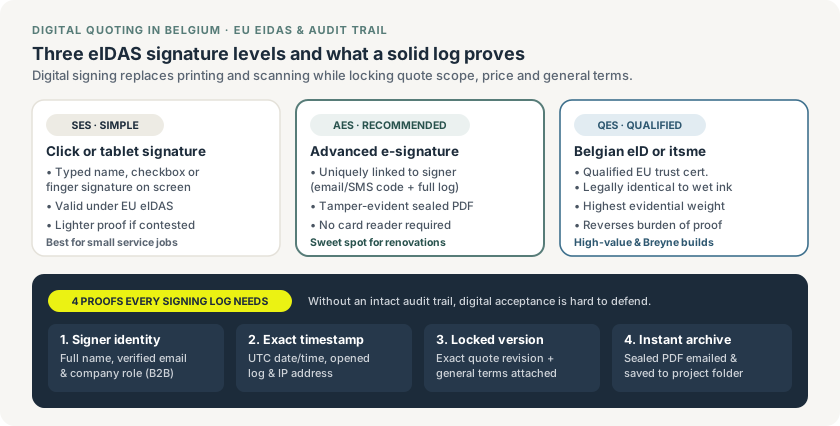
The three EU eIDAS signature tiers in Belgium and the four proof elements every signed quote should lock in.
Legal validity under Belgian law and EU eIDAS
Belgium applies the EU eIDAS Regulation alongside Book XII of the Belgian Code of Economic Law (Wetboek van economisch recht / Code de droit économique). A signature cannot be dismissed simply because it is electronic. eIDAS recognises three tiers with increasing evidential strength:
| eIDAS level | How the client signs | Evidential weight in Belgium | Typical construction fit |
|---|---|---|---|
| Simple (SES) | Typed name, tick-box or finger signature on a tablet | Legally valid, but easier to dispute if not paired with strong logs | Small repairs, reactive service calls, minor extras |
| Advanced (AES) | Uniquely linked to the signer (e.g. verified email/SMS code + tamper-evident PDF) | Strong contractual proof; detects any post-signing edits | Standard renovations, technical installations, SME B2B quotes |
| Qualified (QES) | Belgian eID card or itsme via a qualified trust service provider | Legally equivalent to a handwritten signature; reverses burden of proof | High-value turnkey builds, Breyne Act contracts, complex B2B subcontracts |
For most Belgian renovation quotes between €2,500 and €50,000, an Advanced Electronic Signature (or a well-logged digital acceptance sealing the PDF and general terms) hits the right balance: zero card-reader friction for the customer and clear proof if a scope dispute surfaces six months later. For major turnkey builds or public-facing contracts, step up to itsme or Belgian eID (QES).
How a clean digital signing workflow runs
A reliable workflow takes less than two minutes for the client and stops version mix-ups before site work starts:
- Finalise the quote version in your estimating software, including clear line descriptions, VAT assumptions (6%, 21% or co-contractor) and your general terms and conditions.
- Send a secure online signing link rather than an unlinked static PDF attachment.
- Track when the client opens the quote so you can follow up at the right moment instead of guessing whether the email went to spam.
- Capture acceptance and general terms together: the customer reviews the locked version, ticks acceptance of your general terms, enters their full name (and company role for B2B), and confirms via link/code or on-screen signature.
- Seal and archive automatically: both parties immediately receive the locked signed PDF, and the acceptance log attaches straight to the project record so your team can trigger the advance invoice cleanly.
Four proofs your signing log must capture
An email saying "OK, go ahead" leaves room for arguments over which version of the quote the client accepted — especially after two rounds of revisions. Make sure your signing record locks four details together:
- Signer identity: Full name, verified email address (or phone/itsme verification) and signing authority for B2B clients.
- Exact timestamp and IP trail: Date and time the quote was sent, viewed and signed, plus IP metadata.
- Exact document version and general terms: A tamper-evident sealed copy showing which revision (e.g.
Q-2026-0412 v2) and which general terms were accepted — see our construction document version control practices. - Permanent project archive: Stored centrally with your quote, later change order tickets and final invoices.
Handling hesitant clients without losing speed
| Common concern | Practical response on Belgian sites |
|---|---|
| "Older homeowners prefer paper" | Almost every Belgian household already uses online banking or itsme. Send a clean signing link by default, and keep a PDF print option only for genuine exceptions. |
| "We need to talk through the quote first" | Walk through the details on site and hand the client your tablet to sign on the spot — personal contact plus instant digital proof. |
| "What if the client asks for extra work mid-site?" | Never rely on a verbal nod; send a short digital change order ticket for mobile sign-off before ordering materials. |
| "What about B2C cooling-off rights?" | If you sign off-premises (e.g. at a homeowner's kitchen table) with a consumer, check Belgian Book VI withdrawal-period wording in your general terms with a legal adviser. |
Connect signed quotes straight to projects and Peppol billing
Digital signing pays off most when the approved quote does not sit in an isolated e-sign tool. When acceptance flows directly into project scheduling, from quote to invoice tracking and Peppol invoicing, nothing gets retyped between sales and site execution.
See how Enfin estimating and Enfin construction software handle online quote acceptance, document history and invoicing in one place, or review Enfin pricing.
Signing a renovation contract at the customer's home in Belgium
Identify an off-premises renovation contract, deliver the required information and preserve withdrawal evidence before work begins.
Digital construction work orders with labour, materials and signature
Replace paper work orders with mobile tickets capturing hours, van materials and client sign-off, ready for fast Peppol invoicing in Belgium.
Digital delivery notes: a simple smartphone workflow for construction sites
Learn how to replace paper delivery notes with a quick mobile process, link them to projects and keep documentation searchable and auditable.