Daily cost-to-complete review: focus construction teams on exceptions
Review only the project assumptions that changed: remaining labour, materials, subcontracting, dates and approved scope with clear owners.
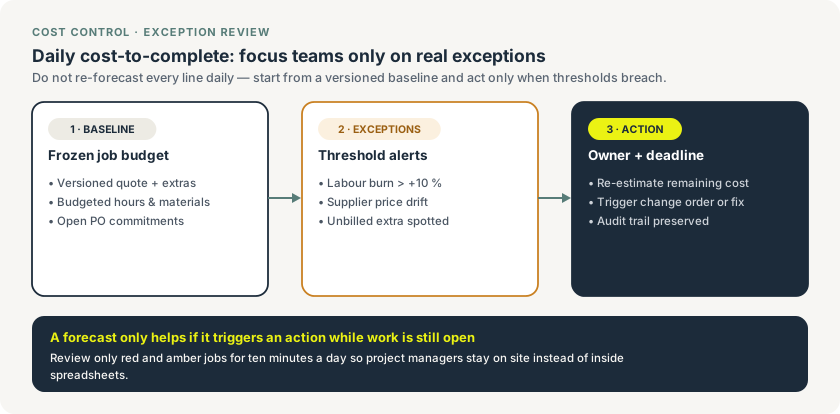
A cost-to-complete forecast becomes noise when the team rebuilds every number every day. It also becomes dangerous when no one revisits it until month-end. A short daily exception review offers a middle path: preserve the accepted baseline, surface only material changes and assign each uncertainty. This helps Belgian construction SMEs connect site facts with purchasing, planning and margin without pretending the forecast is an automated truth.
Start from a versioned baseline
Use the latest approved budget and remaining-cost forecast. Record its date and owner. Do not compare today’s site data with an unknown spreadsheet copy. The baseline should separate labour, materials, subcontracting, equipment and risk allowances.
Keep accepted scope distinct from pending changes. Otherwise an unapproved client request can make forecast margin appear better or worse without explanation.
Protect the baseline from silent edits: every forecast revision needs a date, reason and accountable owner.
Collect only changed facts
Ask what changed since the previous review: hours used, productivity, quantity, supplier price, delivery, subcontractor commitment or completion date. Link each fact to a site report, receipt, order or decision.
Avoid broad status statements such as “almost done”. Estimate the remaining activity and identify what evidence supports that estimate.
Set exception thresholds
Define when an item needs attention, using amount, percentage, time or confidence appropriate to the company. A small variance may matter on a thin-margin package; a larger movement may be normal on a preliminary allowance.
Thresholds should reduce noise, not hide accumulation. Group repeated small changes when their combined effect becomes material.
Give uncertainty an owner and date
Every exception needs a person who can resolve it and a next review date. Examples include confirming a supplier quote, measuring remaining work or obtaining client approval. A colour without an owner is not management.
Record the current best estimate separately from the unresolved question. This keeps the forecast usable while uncertainty remains visible.
Protect the forecast from silent edits
When an assumption changes, store old value, new value, reason and evidence. Do not overwrite historical forecasts. The project lead and finance should be able to explain when the outlook moved and what caused it.
Restrict who can approve budget or forecast changes. Read access can be broad; write and confirmation rights should match responsibility.
Use the review to trigger work
Close the meeting with a small action list: renegotiate, reorder, replan, document a change or adjust the invoice forecast. Review yesterday’s open exceptions before adding new ones. The goal is earlier decisions and a more credible remaining-cost view, not a dashboard that changes without action.
Read also construction job costing and project control with Enfin.
An AI document retention policy for Belgian construction teams
Set purpose, access, provider controls, retention and deletion rules before construction documents enter an AI-assisted workflow.
Mandatory Peppol e-invoicing in Belgium (2026): scope, rules and exceptions
Belgium's B2B Peppol e-invoicing mandate has been live since 1 January 2026. Check who is in scope, which exceptions apply and how contractors stay compliant.
Plan the Cost of Switching Business Software
Estimate and control a software migration by scoping data, open work, integrations, training, parallel operation, archives and acceptance tests.