Construction progress billing without duplicate calculations
How Belgian contractors run cumulative progress billing from BOQ lines to architect sign-off and Peppol B2B invoices without double-billing.
Case C39: correct a submitted claim through a traceable revision
A fictional Belgian finishing job contains 40 m² of wall work at €65 per m². The contractor submits 24 m² for the period, worth €1,560 excluding VAT. Joint remeasurement establishes 22 m². The statement has not been invoiced. The required decision is to replace the claim for that period while retaining its original record, rather than treating the difference as work in a later period.
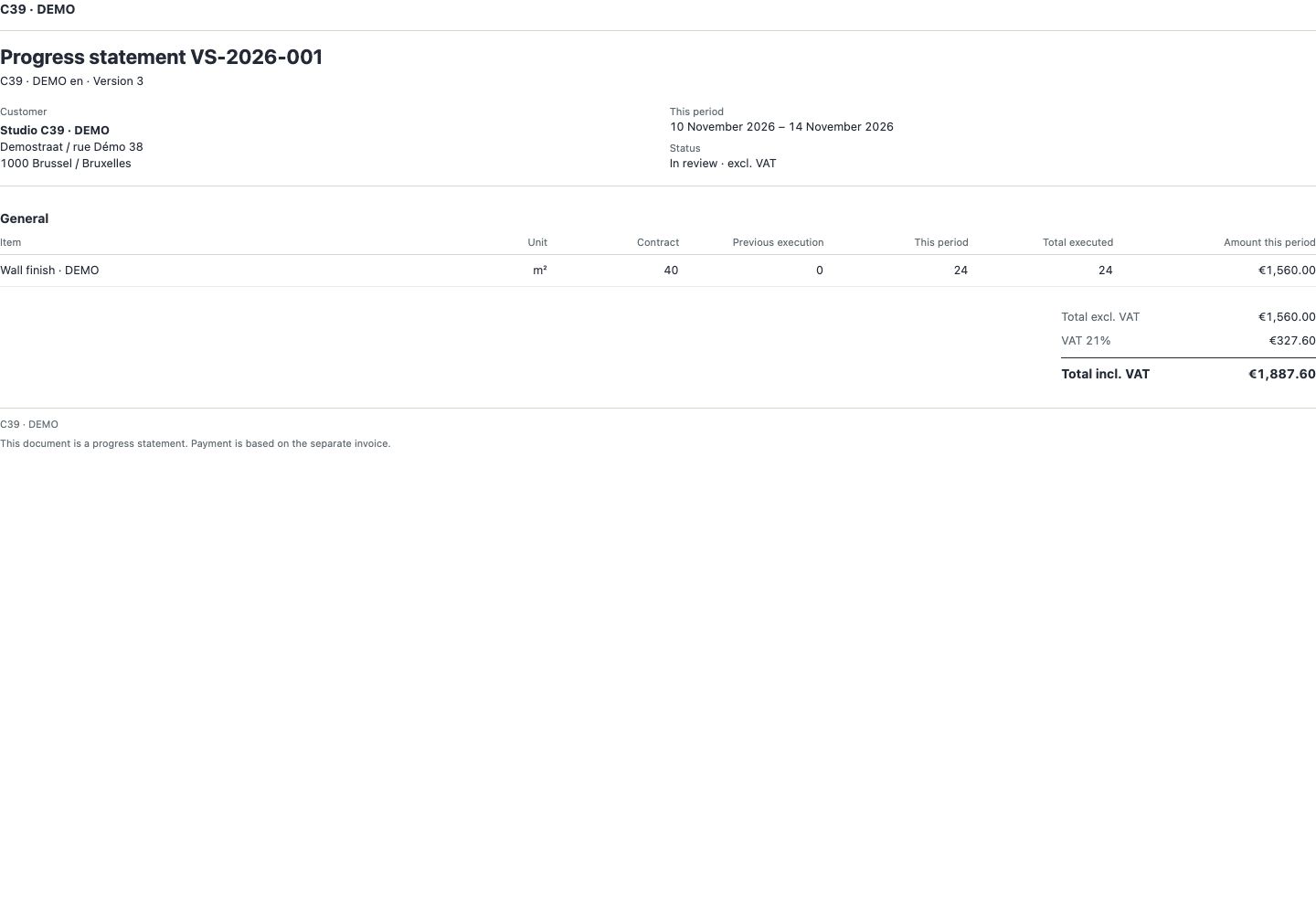
Before: the submitted statement retains the original quantity. This is a genuine Enfin document from a local fictional job.
The local run refused a direct edit to the submitted statement. The revision action created a new draft linked to its predecessor. After saving 22 m² and submitting the revision, an independent readback found both records: the superseded statement still held 24 m² and €1,560; the new revision held €1,430 for the same period. The €130 difference corrects this claim. No credit note, invoice or payment was created.
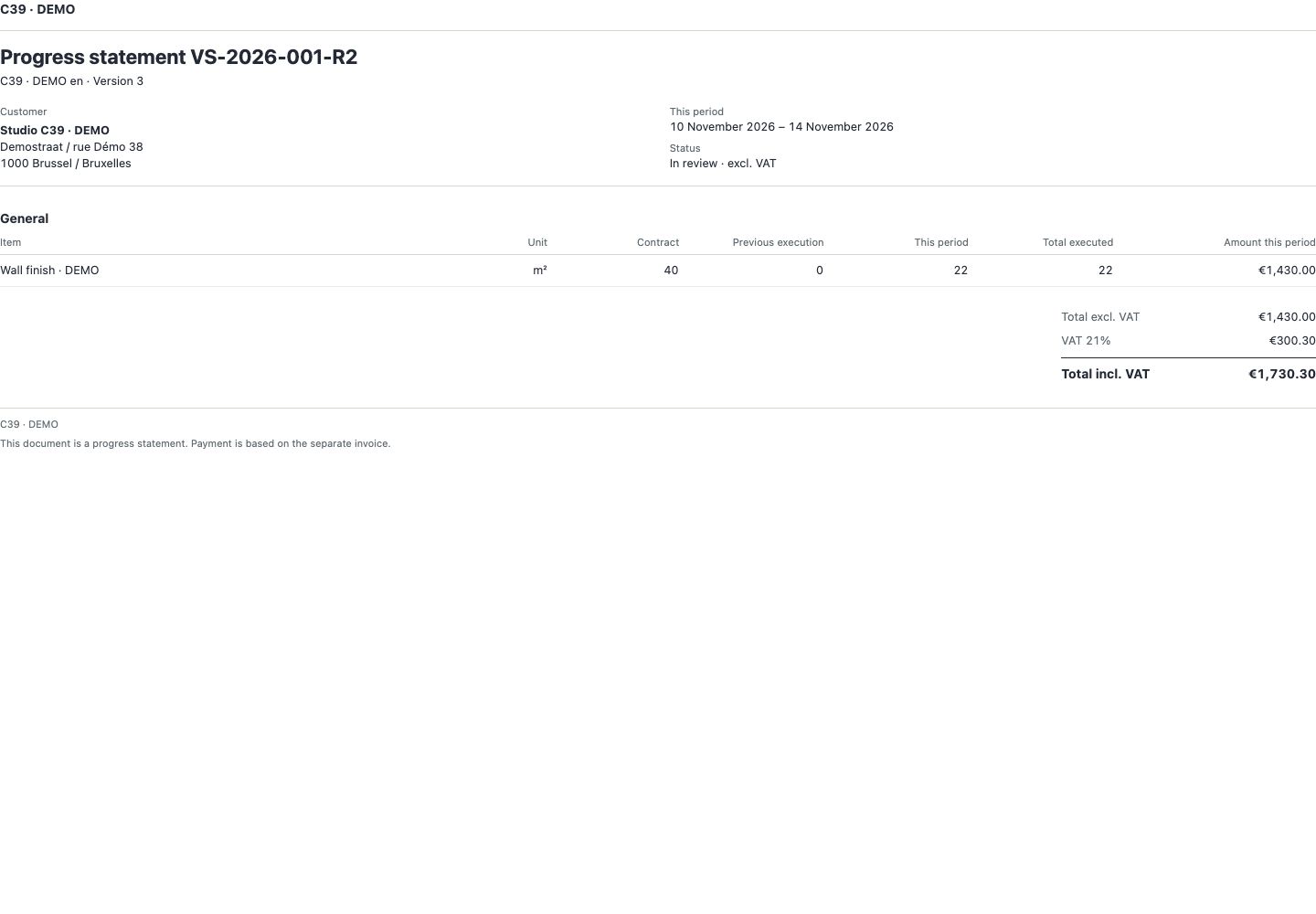
After: R2 identifies the replacement while preserving the period and unit price.
The displayed 21% VAT is a test assumption: €300.30 on €1,430 gives €1,730.30 including VAT. It is not a decision about the project's tax treatment. This example also does not cover an already issued invoice. Obtain acceptance of the revised measurement and document before proceeding to billing.
Case M40: reconcile a manual quantity with its measurement attachment
A fictional contractor enters 20 m² of wall finishing at €65 per m² for the current period. The attachment contains two surfaces measuring 3 × 2 metres and one measuring 2 × 2 metres. Those dimensions support 16 m². The contract allows 40 m², but that does not explain the 4 m² difference in this period's supporting evidence.
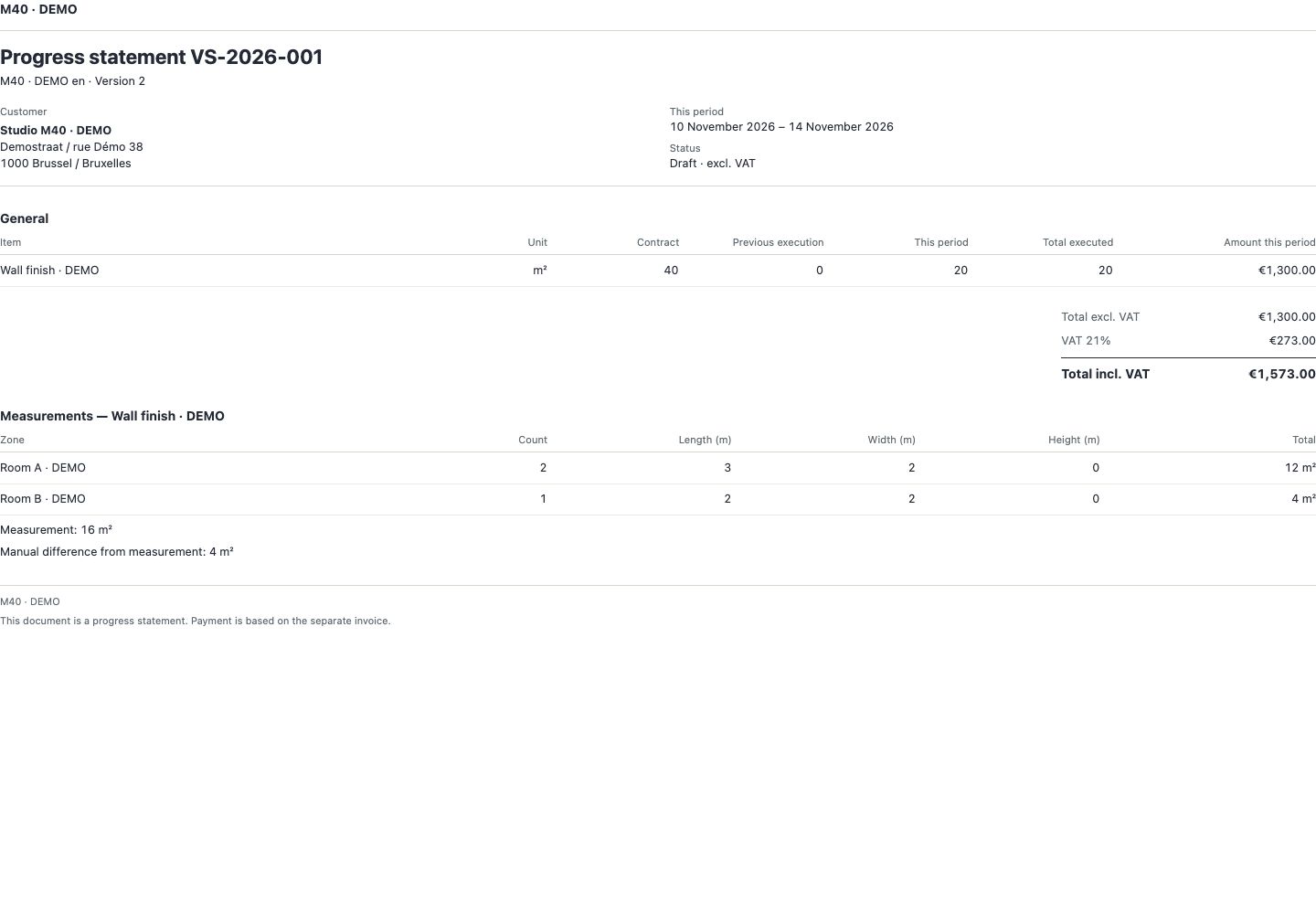
Before: the period line totals €1,300 excluding VAT while the genuine document exposes the measurement difference.
The attachment does not silently replace the manually entered quantity. The local run retained 20 m² until the operator explicitly saved 16 m². After submission and independent readback, the line total was €1,040 excluding VAT, both measurement zones remained stored and the discrepancy was zero. The example demonstrates a visible difference and an explicit correction, not a claim that every measurement difference automatically blocks submission.
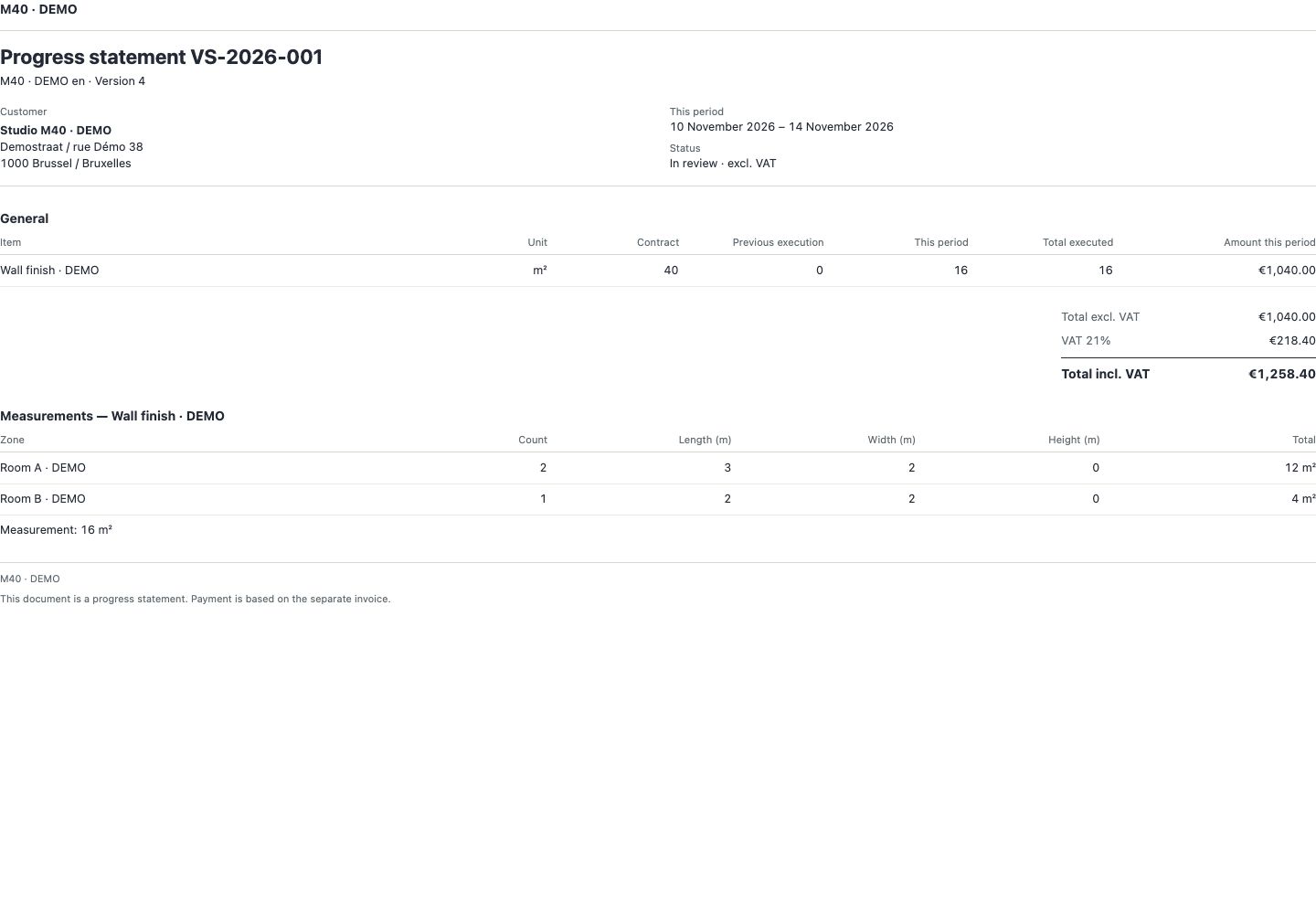
After: the submitted line agrees with its attachment. No invoice was created.
The 21% VAT rate is a synthetic test input: €218.40 VAT and €1,258.40 including VAT. Check the actual project's tax basis separately. A missing surface may justify correcting the attachment instead of reducing the claim. The responsible person must assess scope, measurement rules and acceptance; the arithmetic alone cannot decide which record describes the work correctly.
Practice case P37: keep the submitted quantity separate from approval
A fictional Belgian contractor has a contract for 40 m² of wall finish at €65 per m² before VAT. The contractor submits 20 m², worth €1,300 before VAT. Only 15 m² is accepted during review; the remaining 5 m² awaits a joint measurement in this example.
In the local Enfin demonstration, the submitted quantity remains 20 m². The decision separately stores 15 m² and €975 before VAT as approved. The outstanding 5 m² represents €325 before VAT. Keeping those figures separate preserves the original claim instead of silently rewriting it to match the accepted amount.
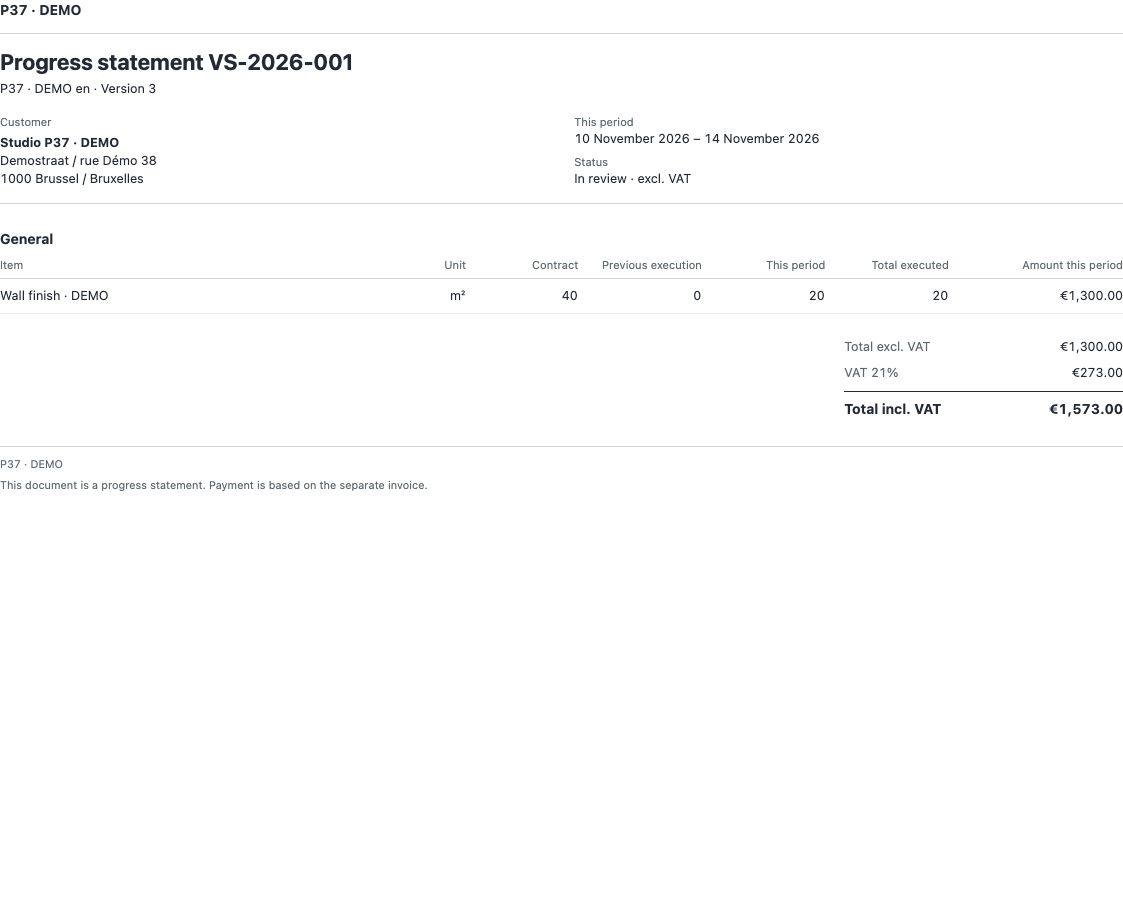
Before: the statement is in review. Open the original document at full size.
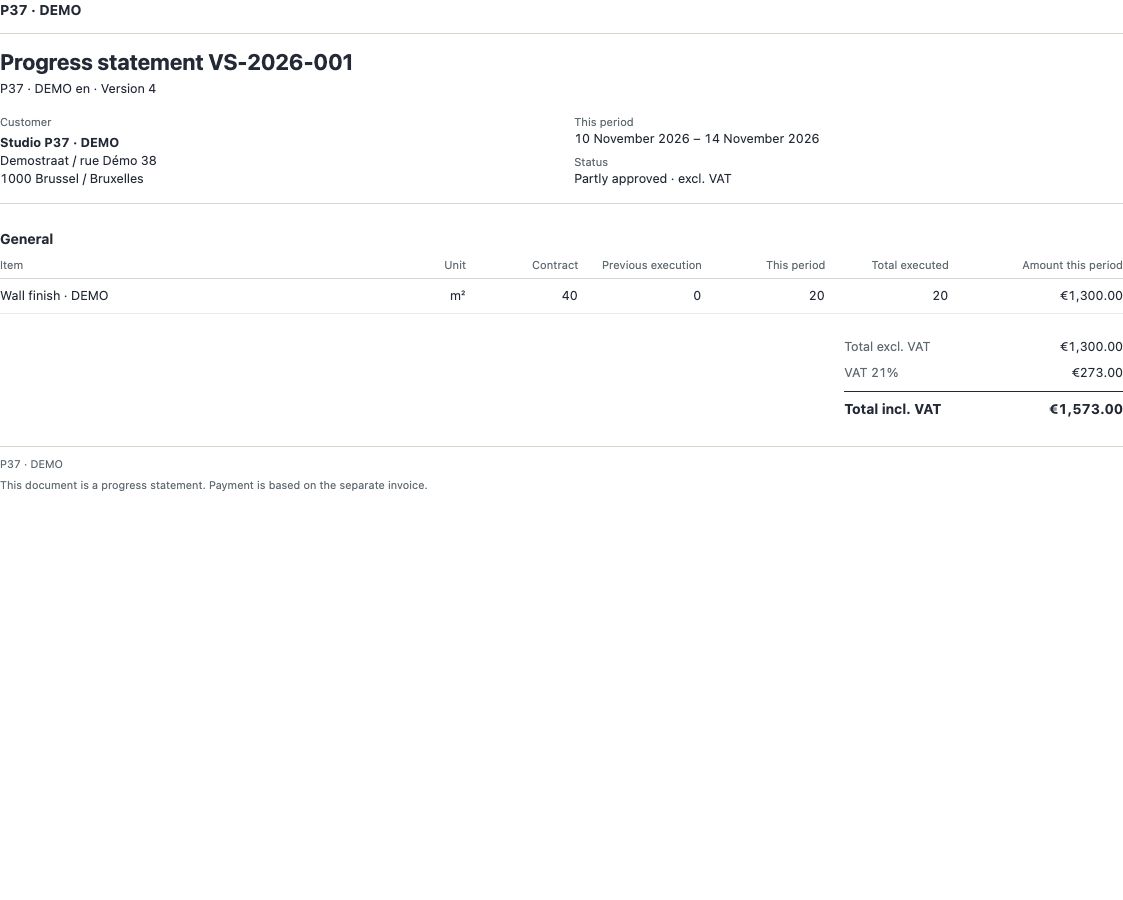
After: the status changes to partly approved. The document still shows the €1,300 claim, not the €975 approved amount. The stored decision must therefore be checked separately before the next financial step. Open the document after review.
The displayed €273 VAT and €1,573 including VAT relate to the €1,300 submitted base and a 21% test assumption. They do not establish an approved invoice tax base. No invoice was created or sent. An independent readback of the local records confirmed the submitted and approved quantities, approved amount, language and recorded reason.
Practice case S38: absorb extra execution without hiding the quantity
A separate fictional job also contracts 40 m² at €65 before VAT, but the site records 44 m² completed. The contractor explicitly chooses to absorb the extra 4 m². This is the commercial decision assumed for the example, not a rule that all work beyond a contract quantity must be free.
While the excess has no recorded resolution, Enfin rejects submission of the statement. The failed attempt leaves its draft status and version unchanged. Recording the excess as non-billable, with the reason “absorb the cost of 4 m² extra execution”, allows submission. An independent local database readback confirms 44 m² executed, the stored decision and a period amount of €2,600 before VAT.
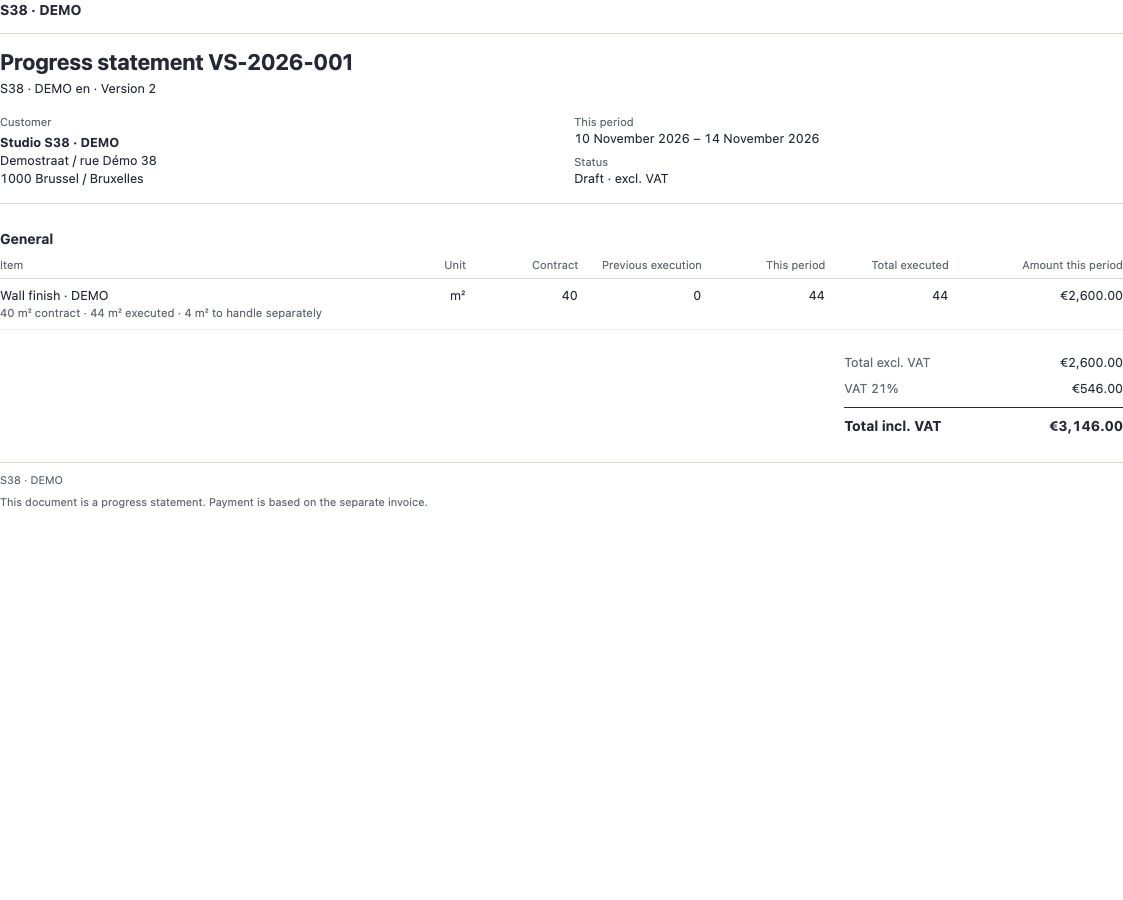
Before: both the contractual and executed quantities remain visible. Open the draft document.
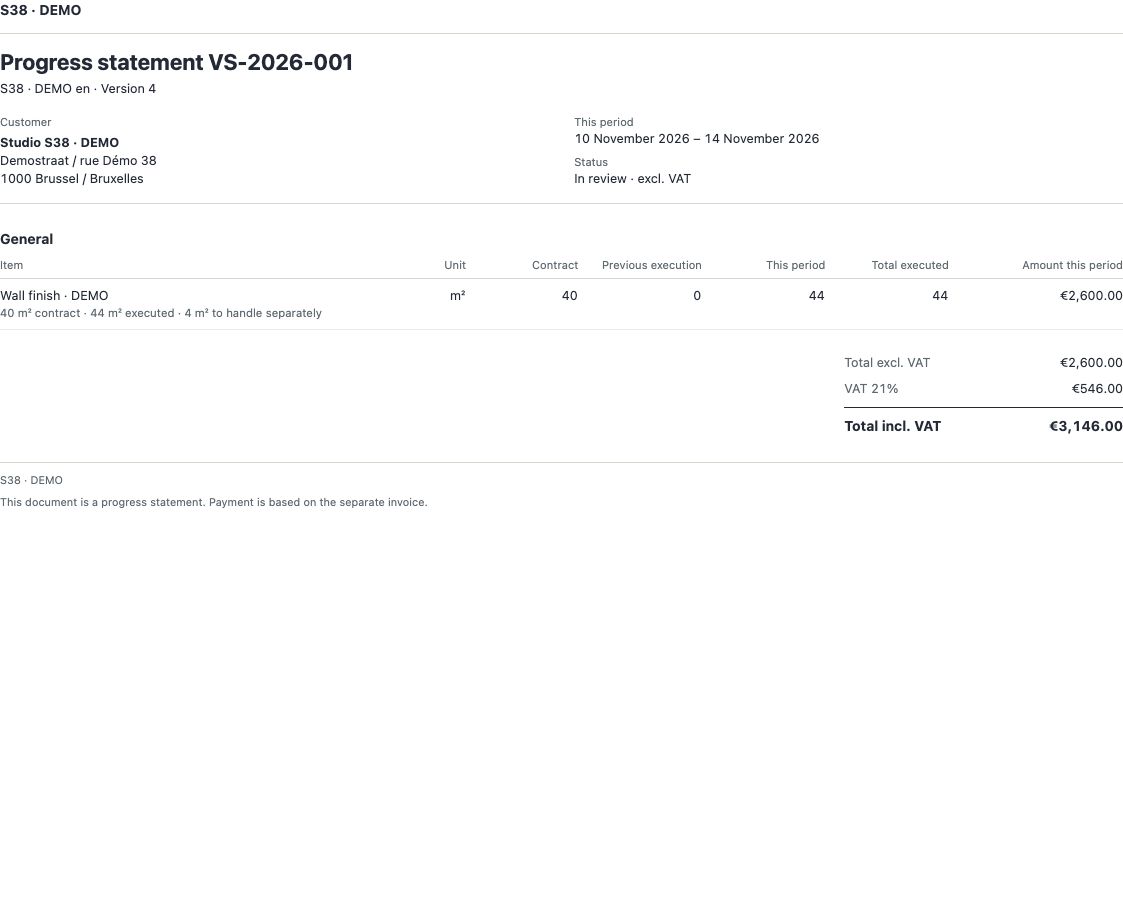
After: the statement can enter review, with €2,600 rather than €2,860. The document line still identifies the 4 m² as requiring separate treatment; the detailed reason remains in the decision data. Open the submitted document.
Using the 21% test input, the document calculates €546 VAT and €3,146 including VAT. It remains a progress statement, with neither an invoice nor customer approval demonstrated. Both workflows ran locally with fictional data. For a real job, reconcile the contract, recorded decision and separate invoice before sending anything to the customer.
Practice case P36: carry approved quantities into the next statement
A fictional Belgian project has an accepted quotation for 40 m² of wall finish at €65 per m² before VAT. In the local Enfin demo, the first progress statement was saved and approved for 12 m². Its value is €780 before VAT, and it remains linked as the predecessor of the next statement.
The next measurement reaches 25 m² in total. That is cumulative progress, not another 25 m² of new work. Enfin carries forward the approved 12 m² and calculates 13 m² for the new period. At the agreed unit rate, the second statement therefore shows €845 before VAT. The cumulative value is €1,625, reconciled by €780 plus €845.
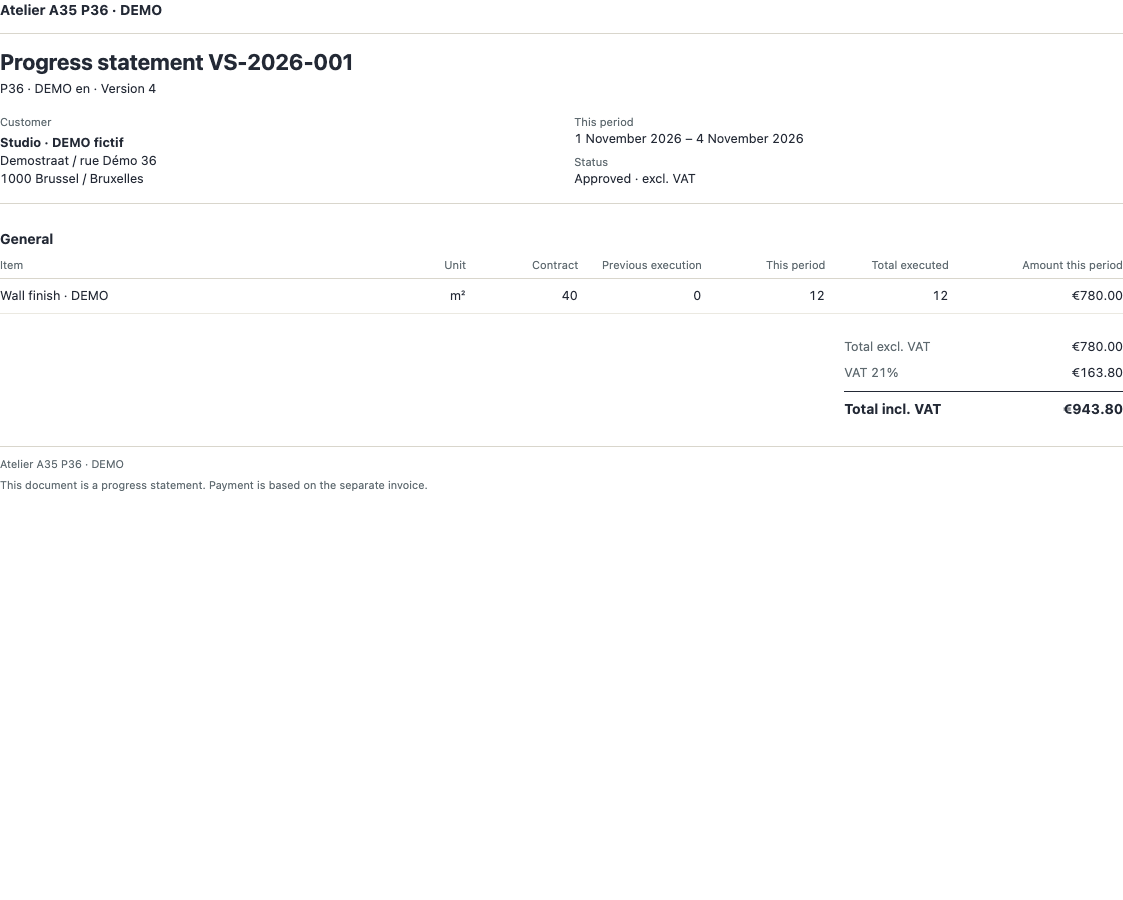
Open the first statement at full size Before: the approved statement records 12 m² against the 40 m² contract quantity.
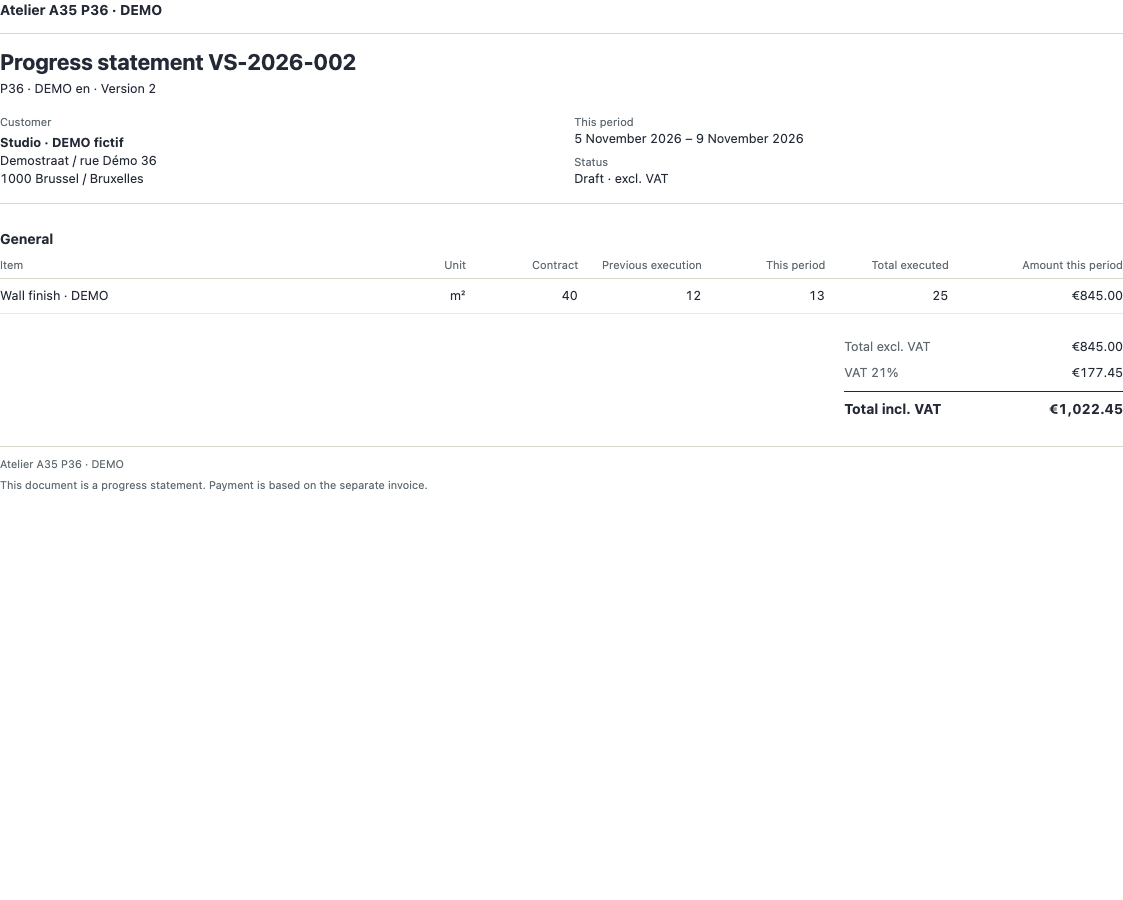
Open the second statement at full size After: only the additional 13 m² appears in the period column.
The demo supplies 21% VAT as a test assumption. On the €845 tax base, Enfin calculates €177.45 VAT and €1,022.45 including VAT. The example does not establish which VAT treatment applies to a real Belgian project.
An independent readback of the saved records confirmed the quantities, unit, language and predecessor link. The second statement remains a draft. No customer invoice was created or sent. These are original Enfin document views rendered from fictional local records. Before invoicing, check the approved statement and reconcile the amounts already invoiced.
How cumulative progress billing keeps BOQ lines clean
Every practice case above solves the same structural problem Belgian contractors run into on multi-month jobs: once spreadsheets copy quantities from month to month, a single broken formula or unrecorded architect adjustment causes double-billing or unbilled work.
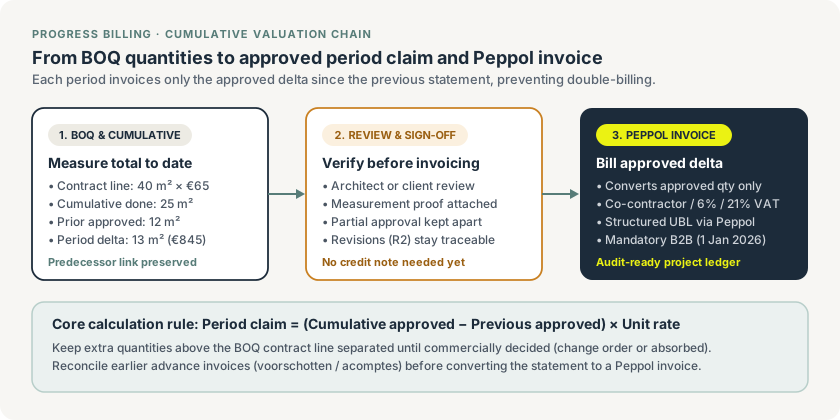
Cumulative progress billing chain: measure total progress against BOQ lines, record formal review decisions, then convert only the approved delta into a Peppol invoice.
The standard Belgian progress statement (vorderingsstaat / état d'avancement) tracks every bill-of-quantities (BOQ) line cumulatively rather than entering isolated monthly estimates. The difference between cumulative billing and period-only billing is clearest when quantities change mid-job:
| Column on a progress statement | What it represents | Why it prevents errors |
|---|---|---|
| Contract BOQ quantity | Agreed scope from the signed quote or tender | Immediately flags over-runs like the 44 m² vs 40 m² in Case S38 |
| Previous approved cumulative | Sum of all earlier approved statements | Carried forward automatically from the linked predecessor (Case P36) |
| Current cumulative measured | Total physical work completed on site to date | Verified directly on site against measurement sheets (Case M40) |
| Period delta | Current cumulative minus previous approved | The only quantity multiplied by the unit rate for this period's claim |
| Approval status & revision | Submitted, partly approved, revised (R2), or approved | Keeps disputes resolved before any fiscal invoice or credit note is created |
When an architect trims 20 m² down to 15 m² (Case P37) or a joint remeasurement lowers 24 m² to 22 m² (Case C39), cumulative accounting automatically carries the exact approved figure into next month's starting column. You never have to hunt through four Excel tabs to remember whether 5 m² was already billed or deferred.
Separate contract progress from extra work and advances
Two common billing traps delay payment on Belgian building sites: mixing extra work into contract BOQ lines and miscalculating advance deductions.
First, treat work beyond the original BOQ explicitly. If the site executes 44 m² on a 40 m² line, either log a priced change order ticket signed by the client or architect before billing the extra 4 m², or formally record the excess as absorbed (as in Case S38). Silently inflating a contract line invites an immediate rejection of the entire monthly statement.
Second, reconcile earlier advance invoices (voorschotfacturen / factures d'acompte) transparently. On Belgian residential projects covered by the Breyne Law, advances are capped (maximum 5% upon contract signature, with remaining instalments tied to completed stages). Showing the gross cumulative valuation, deducting previously invoiced advances or progress statements, and stating the net period amount due removes the main reason clients hold back payment.
Approval sign-off, Belgian VAT and Peppol 2026 B2B invoicing
Never issue the fiscal invoice until the progress statement is formally approved by the architect, project manager, or client. Changing a draft statement or issuing a revision R2 costs nothing; reversing an already issued fiscal invoice requires a formal credit note and slows down cash collection by weeks.
Once approved, check two Belgian compliance rules before converting the statement to an invoice:
- VAT regime per project: B2B work between Belgian VAT-registered parties falls under co-contractor reverse-charge VAT (Royal Decree No. 1, art. 20), which requires the mandatory Belgian one-month contestation clause on the invoice. Private renovations of homes older than 10 years qualify for the 6% renovation VAT rate using the mandatory legal clause on the invoice instead of the old paper certificate. New builds and non-qualifying work carry 21% VAT.
- Peppol B2B delivery: Since 1 January 2026, structured e-invoicing over the Peppol network is mandatory for Belgian B2B transactions. Converting an approved progress statement directly into a structured UBL invoice preserves line references, BOQ codes, and period numbers without manual re-typing, while keeping the signed PDF statement attached as supporting evidence.
Pre-invoice checklist for every progress statement
- Verify every BOQ line links to the prior approved statement's cumulative quantity.
- Attach site measurement sheets or room schedules whenever a line moves significantly.
- Confirm partial approvals or revisions (R2) reflect the exact approved base before generating the invoice.
- Separate signed change orders from original contract lines so both stay auditable.
- Check the VAT basis (reverse-charge co-contractor, 6% renovation, or 21%) and send B2B invoices as UBL via Peppol.
Comparing tools for Belgian project administration? Read the guide to Belgian construction software, see how Enfin invoicing links quotes, progress statements and Peppol invoices, or view pricing.
Advance invoices and progress billing in Belgian construction
Structure Belgian construction advance invoices and progress bills cleanly: sample schedule, Breyne Act 5% cap, VAT timing and Book XIX rules.
Project cash forecasting with progress billing in Belgium
Build a practical construction cash forecast from progress billing, supplier commitments, VAT timing and realistic payment dates.
Duplicate supplier invoices in construction: stop double project costs
Detect repeated supplier charges across files and channels, review the evidence and prevent duplicate cost or payment without hiding exceptions.