Missing a structured Peppol invoice: protect VAT deduction evidence without inventing compliance
Handle a missing Belgian structured B2B invoice with a documented correction path, VAT evidence review and no unsupported compliance assumptions.
Treat the missing format as an evidence problem
For a Belgian B2B transaction that falls within the structured e-invoicing obligation, the buyer should hold a regular structured invoice before exercising VAT deduction. A PDF, email or payment record may show that a transaction happened, but it does not automatically satisfy the invoice-format requirement. Separate three questions: whether the supply occurred, whether the VAT amount is materially correct and whether the invoice evidence meets the formal rule. Do not collapse those checks into a single paid or approved status.
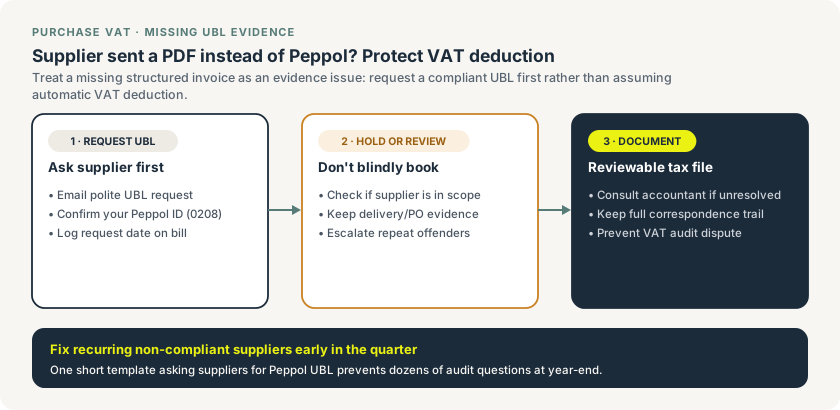
Substance-over-form principles are never a casual shortcut — keep every correction request and accountant review on record.
Ask the supplier for a correction first
Record the supplier, invoice number, invoice date, amount, VAT treatment and the channel actually received. Ask the supplier to issue or resend the structured invoice and link the request to the accounting item. Avoid creating a replacement invoice on the buyer's side. If the supplier disputes the obligation, capture the reason and route it to the accountant instead of labelling the document compliant. A clear pending state protects both payment handling and later VAT review.
Substance over form is not an automatic shortcut
Belgian guidance notes a conditional substance-over-form exception when the material requirements are met. That is not a software default and not permission to ignore the structured-invoice obligation. Applying the exception requires a case-specific tax assessment and evidence. Keep contracts, delivery proof, payment evidence and correspondence, but mark them as supporting documents rather than silently converting them into a compliant invoice. The same workflow should also flag whether the business can technically receive structured invoices.
Keep the tax decision reviewable
The Belgian federal e-invoicing FAQ explains the regular-invoice requirement, the conditional exception and the possible administrative fine for lacking the technical means to receive. Store the source date, correction request, supplier response and the accountant's decision together. If the structured invoice later arrives, reconcile it to the pending item rather than booking a second cost or losing the earlier evidence trail.
Turn the decision into a controlled workflow
Do not leave this control in an isolated note. Record who checks the inputs, which source supports the decision, which exception requires human review and who confirms the final action. Enfin can bring customer, project, quote and invoice context together, while Alfie can prepare or execute actions within verified permissions. That is not a substitute for legal or tax advice, but it makes the contractor's control repeatable. Explore Enfin, review pricing, or discuss the workflow.
Construction closeout: resolve missing documents before the final invoice
Use a closeout gate for certificates, photos, acceptance points, changes and unbilled work before issuing the final construction invoice.
Peppol technical failure in Belgium: use the fallback without losing control
A practical 2026 workflow for Belgian construction SMEs when a recipient cannot technically receive a structured e-invoice.
Supplier invoice without a project reference: route the exception before posting
Resolve a Belgian construction supplier invoice that lacks a project or purchase reference with an owned evidence and coding workflow.